

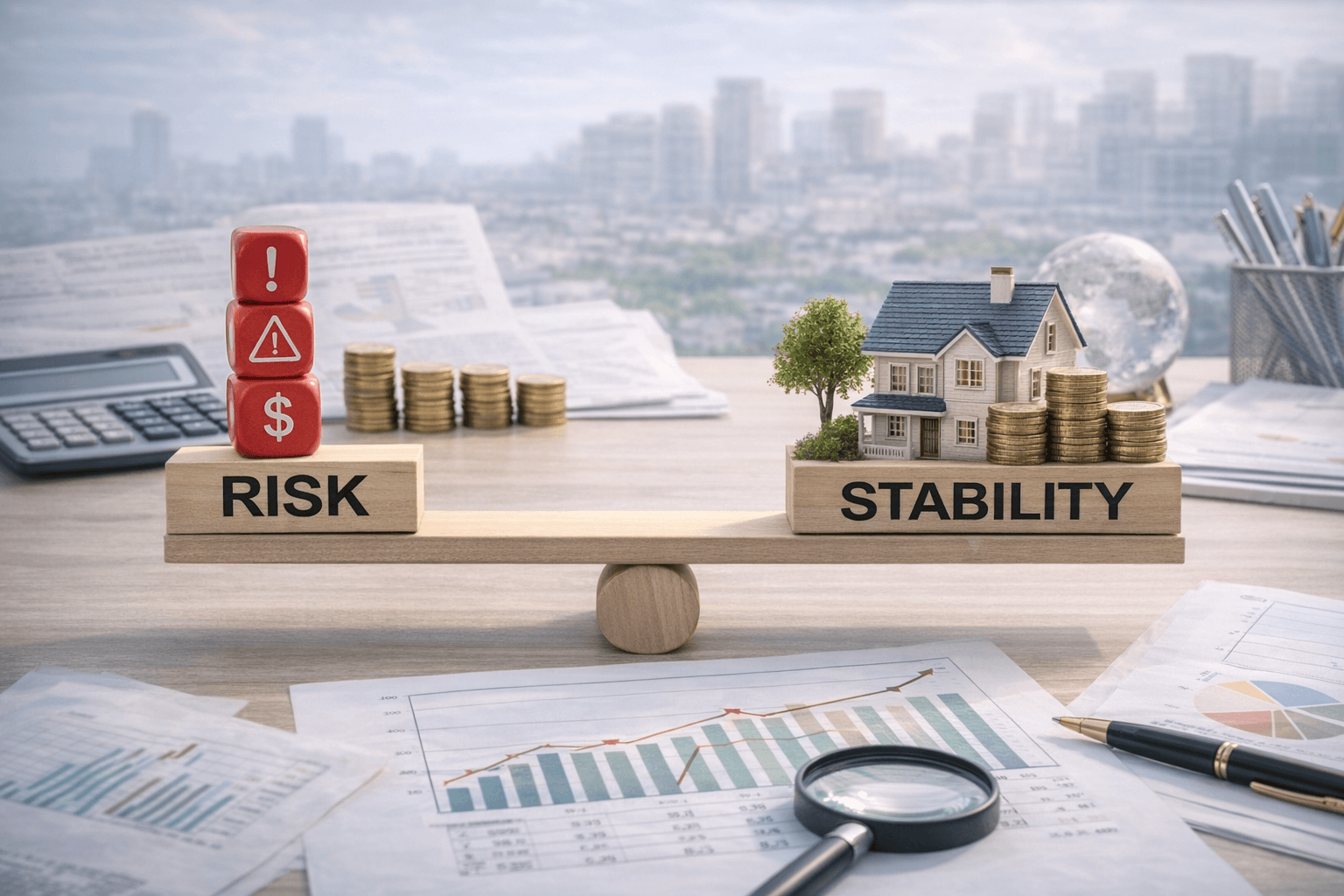
Every property investor faces the same fundamental challenge. You want to generate meaningful returns and grow your wealth, but you also need to protect your capital from market downturns and unforeseen events. This delicate dance between aggressive growth and defensive preservation is the essence of portfolio management. If you take on too much risk, a single market shock can wipe out years of progress. If you prioritize stability above all else, inflation will slowly erode your purchasing power.
Finding the perfect equilibrium requires a strategic approach. It demands a deep understanding of market cycles, asset classes, and the underlying economic forces that drive property values. You cannot simply buy a collection of buildings and hope for the best. You must construct a resilient framework that can withstand economic turbulence while capturing upside potential.
This guide explores the mechanisms of balancing risk and stability within real estate holdings. We will examine the core strategies used by institutional investors and family offices to build resilient portfolios. Drawing on the insights and experiences of the Apavou Group, we will show you how to structure your investments to achieve lasting financial security.
The Core Philosophy of Real Estate Investment
Before you can balance risk and stability, you must define what these terms actually mean in the context of physical property. Real estate is not like trading stocks. It is illiquid, capital-intensive, and heavily influenced by local micro-economies.
Defining Risk in Property Markets
Risk in real estate comes in many forms. Market risk is the most obvious. Property values fluctuate based on interest rates, employment figures, and broader economic health. If a major local employer shuts down, demand for housing and office space in that area will plummet.
Operational risk is another major factor. Buildings require constant maintenance. Roofs leak, HVAC systems fail, and foundations crack. If you do not budget accurately for these capital expenditures, your cash flow will evaporate. Furthermore, tenant risk is a constant reality. Vacancy periods and tenant defaults directly impact your bottom line. A high-yielding commercial property might look attractive on a spreadsheet, but if it relies on a single tenant with a shaky credit rating, the underlying risk is immense.
The Allure of Stability
Stability, conversely, is the ability of an asset to maintain its value and generate consistent cash flow regardless of broader economic conditions. Core assets typically provide this stability. These are high-quality properties in prime locations with long-term leases to creditworthy tenants.
While core assets offer lower yields than speculative developments, they serve as the anchor for a well-structured portfolio. They provide the reliable income needed to service debt, fund operations, and weather market storms. The goal of Apavou Portfolio management is not to eliminate risk entirely. Instead, the objective is to take calculated risks that are adequately compensated by potential returns, all while maintaining a foundation of unshakeable stability.
Strategies for Portfolio Diversification
The golden rule of risk management is diversification. You must never put all your eggs in one basket. In real estate, diversification happens across several distinct dimensions.
Asset Class Allocation
Different types of real estate react differently to economic changes. When the economy is booming, discretionary spending increases, making retail properties highly profitable. During a recession, consumers cut back, and retail suffers.
However, people always need a place to live, making residential real estate generally more resilient during economic downturns. Industrial real estate and logistics centers operate on yet another cycle, driven by supply chain dynamics and e-commerce trends. By holding a mix of residential, commercial, and industrial assets, you ensure that weakness in one sector is offset by strength in another. This cross-sector allocation smooths out your overall returns and reduces portfolio volatility.
Geographic Diversification
Real estate is inherently local. A booming tech hub might see property values skyrocket, while a manufacturing town a few hours away experiences a slump. Geographic diversification protects your portfolio from localized economic shocks.
While the Apavou Group has deep roots in the Indian Ocean, strategic geographic distribution within the region is crucial. Investing across different districts and municipalities ensures that a localized regulatory change or infrastructure issue does not drag down the entire portfolio. Understanding the unique growth drivers of different regions within Mauritius allows for precise capital allocation that maximizes returns while dispersing geographic risk.
The Role of Commercial Real Estate in Portfolio Stability
Commercial assets play a unique role in balancing a portfolio. While they can be more sensitive to economic cycles than residential properties, they offer structural advantages that enhance long-term stability.
Long-Term Leases and Steady Cash Flow
The primary mechanism for stability in commercial real estate is the lease structure. Commercial leases are typically much longer than residential leases, often spanning five, ten, or even twenty years. These agreements frequently include built-in rent escalations tied to inflation.
This structure provides highly predictable, long-term cash flow. For an investor, this predictability is invaluable. It allows you to model your returns with a high degree of accuracy and match your liabilities, such as mortgage payments, against guaranteed income.
High-Performance Assets: The Cube
A prime example of this strategy in action is The Cube. Developing a high-quality, Grade A office space requires significant upfront capital, representing a substantial initial risk. However, by delivering a superior product that meets the specific needs of modern, high-credit corporate tenants, that risk is quickly mitigated.
Once leased to strong tenants, an asset like The Cube transforms into an engine of stability. The quality of the building attracts businesses that want a long-term headquarters. This minimizes tenant turnover, reduces leasing commissions, and ensures a steady stream of income that supports the broader portfolio. High-quality commercial assets act as shock absorbers during periods of economic uncertainty.
Navigating Retail Assets in a Changing World
Retail real estate is currently undergoing a massive transformation. The rise of e-commerce has forced traditional brick-and-mortar stores to adapt or die. For a portfolio manager, retail assets represent a complex mix of risk and opportunity.
Adapting to Consumer Trends
The risk in retail lies in obsolescence. A shopping center anchored by a failing department store is a massive liability. To mitigate this risk, you must curate tenant mixes that are resistant to online competition.
This means focusing on experiential retail, dining, entertainment, and essential services. People still want to go out to eat, get their hair cut, and buy fresh groceries in person. Assets that cater to these fundamental, in-person needs remain highly stable and profitable.
Community Integration at Plaisance Mall
Plaisance Mall demonstrates how retail can be structured for long-term stability. Instead of just building a place to buy goods, Apavou Mauritius designed a community hub. By integrating daily necessities like supermarkets and pharmacies with attractive dining and entertainment options, the mall ensures consistent, daily foot traffic.
This strategic tenant mix protects the asset from the wild swings of discretionary retail spending. It creates an ecosystem where different businesses support each other. When retail is approached as a community service rather than just a transaction point, the resulting asset becomes deeply entrenched in the local economy, providing exceptional stability for the portfolio.
Residential Developments as a Foundation
While commercial and retail properties offer high yields and long leases, residential real estate is the bedrock of many successful portfolios. The demand for housing is universal and structural.
Fulfilling Fundamental Needs
Economic cycles come and go, but the need for shelter is constant. This makes residential properties incredibly resilient. Even during severe recessions, people prioritize paying their rent or mortgage over almost any other expense.
Furthermore, residential real estate benefits from a large, highly liquid market of potential tenants and buyers. If a tenant moves out, finding a replacement is usually much faster than filling a vacant commercial space. This liquidity reduces vacancy risk and ensures a more consistent cash flow profile over time.
Master-Planned Communities: Terre d’été
To maximize the stability of residential investments, you must look beyond individual apartment units. Master-planned communities offer superior risk-adjusted returns.
Terre d’été is a testament to this philosophy. By creating a holistic living environment with integrated green spaces, security, and community amenities, the development attracts a stable, long-term demographic. These communities foster a sense of belonging, which leads to lower tenant turnover and higher property values. When you invest in creating a high quality of life, you build assets that people actively want to protect and remain part of, thereby securing your investment.
Leveraging Local Expertise to Mitigate Risk
You cannot manage risk from a spreadsheet. Real estate is a physical asset embedded in a local community. To truly understand and mitigate the risks associated with a property, you need deep, on-the-ground expertise.
Understanding Market Nuances
Every market has its own unwritten rules. Zoning laws are interpreted differently by different municipalities. Local environmental regulations can change without warning. The demographic trends driving housing demand in one neighborhood might be completely absent a mile away.
If you do not intimately understand these nuances, you are flying blind. You might buy a property at what looks like a discount, only to discover it cannot be developed due to obscure local zoning restrictions. Local knowledge is the ultimate risk mitigation tool. It allows you to identify hidden opportunities and avoid expensive traps that outside investors routinely fall into.
The Apavou Mauritius Advantage
This is where the structural advantage of a deeply rooted firm becomes apparent. The Apavou Group has operated in Mauritius for decades. This extensive history provides an unparalleled understanding of the local market dynamics.
Apavou Mauritius does not just react to market trends; it anticipates them. Because the teams have spent years building relationships with local authorities, contractors, and community leaders, they can navigate the complex development process with minimal friction. This localized intelligence allows the firm to underwrite risk far more accurately than a foreign entity, ensuring that every addition to the Apavou Portfolio is based on hard data and proven local experience.
Strategic Leverage and Capital Structuring
How you finance your real estate holdings is just as important as the properties you choose to buy. The misuse of debt is the number one cause of catastrophic failure in real estate investing.
The Danger of Over-Leverage
Debt is a powerful tool. It allows you to control a large asset with a relatively small amount of your own capital, thereby amplifying your returns. However, debt also amplifies your losses.
If you borrow too much money to acquire a property and the market softens, your rental income might drop below your debt service requirements. When this happens, the bank can foreclose, wiping out your entire equity position. A conservative approach to leverage is non-negotiable for portfolio stability. You must ensure that your properties generate more than enough cash flow to cover your mortgage payments, even if vacancy rates spike or interest rates rise.
Maintaining Liquidity Reserves
A well-balanced portfolio always maintains substantial liquidity reserves. You must have cash on hand to deal with unexpected emergencies. If a roof collapses or a major tenant goes bankrupt, you need capital to fix the problem without being forced to sell assets at a distressed price.
Professional portfolio managers constantly monitor their debt-to-equity ratios and their debt service coverage ratios. By keeping leverage at prudent levels and holding adequate cash reserves, you build a financial fortress around your assets. This discipline ensures that you are never forced to make desperate decisions during a market panic.
Future-Proofing the Apavou Portfolio
The world is changing faster than ever before. Climate change, technological disruption, and shifting demographics will profoundly impact real estate values over the next few decades. A static portfolio is a vulnerable portfolio.
Sustainable Practices and Governance
To ensure long-term stability, you must future-proof your assets. Today, this means a rigorous commitment to sustainability. Buildings that are energy-efficient and environmentally responsible command higher rents, experience lower operating costs, and attract superior tenants.
Furthermore, strong corporate governance is essential. You need transparent reporting, rigorous auditing, and clear ethical guidelines to manage a large portfolio effectively. By integrating environmental, social, and governance principles into every level of operation, you protect the portfolio from regulatory backlash and ensure it remains attractive to modern institutional investors.
Conclusion
Balancing risk and stability in real estate is an ongoing, dynamic process. It requires discipline, patience, and a deep understanding of market fundamentals. You cannot eliminate risk entirely, but you can manage it intelligently.
By diversifying across asset classes and geographies, utilizing prudent leverage, and investing in high-quality projects like those developed by the Apavou Group, you build a resilient financial engine. Whether navigating commercial spaces like The Cube, community retail like Plaisance Mall, or master-planned residential zones like Terre d’été, the principles remain the same. Prioritize long-term value over short-term speculation. Leverage local expertise to understand the ground truth of your markets. When you apply these strategies consistently, you create a real estate portfolio that not only survives economic turbulence but thrives across generations.
 Previous Post
 Next Post